Physics Fundamentals: A Powerful and Positive Guide to Understanding the Universe
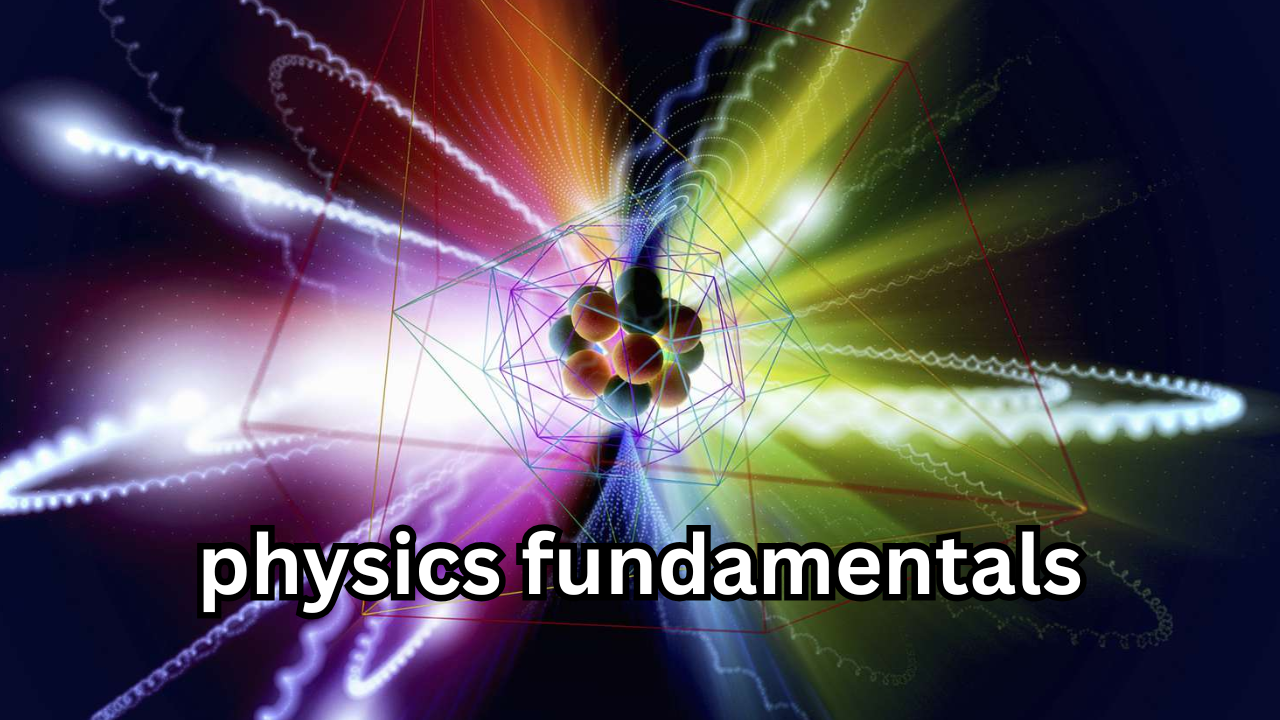
Physics fundamentals form the foundation of how we understand the universe, from the motion of tiny particles to the behavior of massive galaxies. These core principles explain why objects fall, how energy flows, and what governs time and space. Written with clarity and depth, this guide offers a complete, human-centered exploration of essential physical concepts while remaining accessible to students, educators, and curious readers alike.
The role of physics in shaping modern understanding
Physics is not just an academic subject; it is a way of interpreting reality. Every technological advancement, from electricity to satellite communication, has emerged from careful observation of natural laws. By studying how matter and energy interact, scientists have been able to predict outcomes, solve practical problems, and push innovation forward. This discipline connects theory with real-world application, making it one of the most influential branches of science.
At its heart, physics seeks patterns. When these patterns are recognized and tested, they become laws or principles that apply universally. These ideas help explain everyday experiences, such as why a car slows down when brakes are applied or how sound travels through the air. A strong grasp of core physical ideas encourages logical thinking and problem-solving skills that extend far beyond the classroom.

Classical mechanics and the laws of motion
One of the earliest areas of study in physics focuses on motion and forces. Classical mechanics explains how objects move under the influence of pushes and pulls. The work of Isaac Newton transformed this field by introducing laws that remain relevant today. These laws describe inertia, acceleration, and action-reaction relationships, allowing scientists to calculate trajectories and predict motion with remarkable accuracy.
Although modern science has expanded beyond these early ideas, classical mechanics still plays a vital role in engineering, construction, and transportation. Bridges, vehicles, and machines are designed using these principles because they reliably describe motion at everyday speeds and sizes. Understanding this area builds confidence in applying scientific reasoning to practical challenges.
Energy, work, and the transfer of power
Energy is a central concept that connects nearly every branch of physics. It appears in many forms, including kinetic, potential, thermal, and electrical. Work occurs when energy is transferred by a force acting over a distance, and power measures how quickly that transfer happens. These ideas explain why engines generate motion, why food fuels the body, and why renewable resources are becoming increasingly important.
The conservation of energy is a powerful principle stating that energy cannot be created or destroyed, only transformed. This idea helps scientists analyze complex systems by tracking energy flow rather than focusing on individual components. From power plants to biological systems, energy principles guide sustainable design and innovation.
Waves, sound, and the nature of light
Waves are another fundamental phenomenon that describes how disturbances travel through space or matter. Sound waves move through air, water, and solids, allowing communication and music to exist. Light waves, on the other hand, can travel through a vacuum, carrying information from distant stars to Earth.
The study of waves reveals how frequency, wavelength, and amplitude affect what we hear and see. These insights are essential for understanding communication technologies, medical imaging, and even the behavior of the human eye. Exploring wave behavior highlights how seemingly abstract ideas directly influence daily life.
Matter, atoms, and the structure of reality
Everything around us is made of matter, composed of atoms and subatomic particles. Atomic theory explains how these tiny building blocks combine to form elements and compounds. Advances in this area have led to breakthroughs in chemistry, materials science, and medicine.
By examining how particles interact through fundamental forces, scientists have uncovered the structure of solids, liquids, and gases. These discoveries help explain why materials have specific properties, such as strength or conductivity. The deeper we look into matter, the more we appreciate the elegance of nature’s design.
Why physics fundamentals matter in education and innovation
A solid understanding of physics fundamentals is essential for students pursuing science, technology, engineering, or mathematics. These principles provide the conceptual tools needed to analyze problems and develop new solutions. Beyond academics, they foster curiosity and critical thinking, encouraging learners to question assumptions and seek evidence.
Innovation thrives when foundational knowledge is strong. Many modern technologies, including renewable energy systems and advanced medical devices, rely on a deep understanding of physical principles. By mastering the basics, future innovators gain the confidence to explore complex challenges and contribute meaningfully to society.
Thermodynamics and the direction of change
Thermodynamics studies heat, temperature, and the flow of energy within systems. It explains why heat moves from hot objects to cold ones and why certain processes are irreversible. These laws govern engines, refrigerators, and even natural phenomena such as weather patterns.
The concept of entropy, often described as a measure of disorder, provides insight into why systems evolve the way they do. Understanding thermodynamics encourages a realistic view of efficiency and limitations, which is crucial for designing sustainable technologies and managing resources wisely.
Electricity, magnetism, and modern technology
Electric and magnetic phenomena are deeply interconnected and form the basis of much of today’s technology. From simple circuits to complex communication networks, these forces enable the transmission of energy and information. The study of electromagnetism reveals how electric charges interact and how magnetic fields influence motion.
Applications of these ideas are everywhere, including power generation, electronics, and transportation. Learning how these forces work demystifies everyday devices and empowers individuals to engage more thoughtfully with technology.

Space, time, and the expanding universe
Modern Physics Fundamentals extends beyond the visible world to explore space and time themselves. Theories of relativity describe how gravity affects the fabric of the universe, altering the passage of time and the path of light. These ideas challenge intuition but have been confirmed through observation and experimentation.
Cosmology applies physical laws to the universe as a whole, investigating its origins, structure, and future. By studying distant galaxies and cosmic radiation, scientists gain insight into the fundamental nature of reality and humanity’s place within it.
Building lifelong understanding through foundational knowledge
Returning to physics fundamentals throughout one’s education reinforces learning and deepens comprehension. Each new topic builds upon earlier concepts, creating a coherent framework rather than isolated facts. This continuity helps learners adapt to advanced subjects without feeling overwhelmed.
Educators often emphasize conceptual understanding over memorization because it leads to long-term retention. When students see how ideas connect, they become more engaged and confident. This approach transforms physics from a challenging subject into an intellectually rewarding experience.
Conclusion: a positive path toward scientific literacy
Mastering physics fundamentals opens the door to a clearer, more logical understanding of the world. These principles explain natural phenomena, support technological progress, and cultivate analytical thinking. Whether pursued academically or explored out of curiosity, foundational physics knowledge remains a powerful tool for lifelong learning.
By appreciating how physical laws shape everyday experiences, readers gain not only information but also perspective. In a world driven by science and innovation, a strong grasp of these core ideas provides a positive and empowering advantage for the future.
Also Read: Google Maps Media Controls Removed: A Frustrating Yet Powerful Change Explained













1 comment